

KIRKUS REVIEWS
“Martini’s storytelling is vivid and gripping, and his writing reads like lean, muscular poetry. The result is a terrific read with real psychological depth beneath the hard-bitten prose.”
SUBLIME
“Vivid and chilling, this is a riveting tale of the horrors of war and a dangerous truth waiting to be unearthed.”

PRAIRIE REVIEWS
“Martini’s taut prose provides a haunting glimpse into the psychological scars of conflict and the moral dilemmas facing his characters.”
INDIEREADER
“An engrossing historical mystery that unravels before the reader layer by layer, Sandro Martini’s CIAO, AMORE, CIAO explores the depth of cruelty and human suffering caused by war and the exploitation of ordinary people for political interests.”

REVIEWS
“Italy’s buried wartime secrets lead to shocking violence in this labyrinthine historical mystery.”
—Kirkus Reviews
Martini’s novel, based on a real incident, centers around a July 1945 massacre in which left-wing partisans murdered a group of alleged Fascists imprisoned in the town of Schio in northeastern Italy. At the story’s heart is a memoir recounting the investigation of the crime by Lieutenant John Casanova of the United States Army, who combs through possible motives that might include revenge for Fascist atrocities, personal vendettas, and a communist plot to start an insurrection.
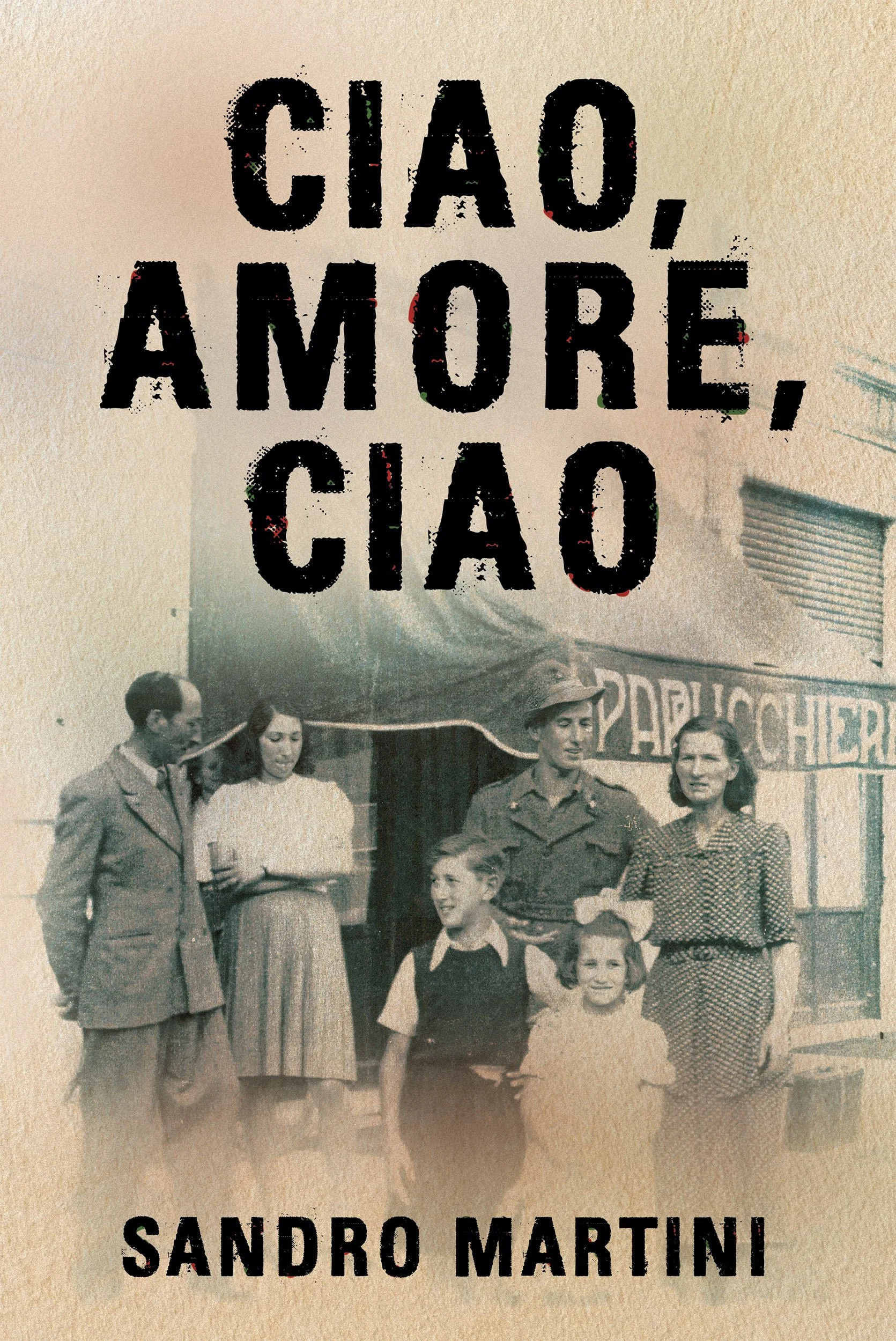
His sleuthing unearths murky relationships between partisan leader Giulio Moro, pro-Fascist businessman Ettore Godin (who was shot but survived), and Renzo Balbo, the partisan who Godin says shot him. Casanova, an Italian-American who despises Italy, probes disdainfully into the corruption and violence but eventually stoops to unconscionable methods—think beatings and cockroaches—in his quest for answers. The novel then shifts to Balbo’s account of the Italian Army’s disastrous retreat from Stalingrad in January of 1943, an ordeal of frostbite, carnage, cannibalism, and betrayal that he endured with Moro and Godin. Framing the novel is the present-day narrative of Alessandro Lago, an Italian journalist who discovers among his dying father’s papers a photograph of Balbo, Moro, and Godin on the Russian Front alongside his uncle Alessandro; the picture entangles him with a mysterious woman who leads him to Casanova’s and Balbo’s writings and neo-Fascist politics. Martini writes in three distinctive registers, switching between Lago’s moody, atmospheric meditation on blighted lives, Casanova’s noirlikedetective story, and Balbo’s grisly, surreal war epic. (“[A] mortar [shell] land[ed] not twenty meters from me, hitting a sled full of injured men and I could see parts of them, pieces of their bodies fully formed cartwheel into the air…I felt that wave of bone and meat rip into my face like shrapnel.”) Martini’s storytelling is vivid and gripping, and his writing reads like lean, muscular poetry. The result is a terrific read with real psychological depth beneath the hard-bitten prose.
A gripping saga that roots excruciating betrayals in a nation’s tragic history.
“Vivid and chilling, this is a riveting tale of the horrors of war and a dangerous truth waiting to be unearthed.”
—Sublime
Based around actual events, this novel unfolds across multiple tim multiple timelines, each steeped in its own brand of tension. It begins with a mystery uncovered by a present-day, disillusioned journalist, Alex Lago, who finds a photograph among his dying father’s possessions—a photograph that attracts the attention of a beautiful woman and sets in motion the revelation of events that began on the battlefields of Stalingrad in 1942 and continued with an American investigation into a brutal massacre in Italy in 1945.
With crisp and wonderfully atmospheric writing, Martini paints vivid portraits of wartime horrors and post-war reckonings. The narrative is fraught with moral dilemmas and unforeseen dangers and is coated with tension and intrigue. Using his masterful command of descriptive narrative, the author balances action, suspense, and emotional depth to deliver a truly immersive, thought-provoking read with an unflinching look at the sins of the past and the lengths to which the powerful will go to keep them buried. This novel is a must-read for fans of historical thrillers layered with espionage and suspense.
“Sprawling, stirring, and beautifully written…”
—Prairie Review
Martini delves into the intersection of history, familial ties, and the lingering scars of conflict in his compelling novel. The story follows Alex Lago, a jaded journalist watching his life unravel. A chance encounter with a World War II photograph sparks a desperate effort to bond with his dying father and propels Alex into the depths of a decades-old mystery rife with dark family secrets. Alternating between Alex’s somber self-reflections, a noir-inspired detective story, and a surreal exploration of wartime madness, the narrative deepens the story’s emotional impact while highlighting the complexity of history. Martini’s taut prose provides a haunting glimpse into the psychological scars of conflict and the moral dilemmas facing his characters. He seamlessly weaves Alex’s emotional turmoil with the vivid backdrop of post-war Italy. As Alex navigates a deep web of betrayal and weight of legacy, readers are pulled into his raw struggle for understanding and redemption. A gripping portrait of a forgotten World War II battle, the novel deftly ties past deceptions to present reckonings.
Historical fiction fans won’t want to miss this one.
“…profoundly moving and thought-provoking.”
—IndieReader
Alexander Lago finds a picture amongst his dying father’s things, which, when he posts it online, draws the attention of a mysterious woman, Sofia, who begs him to take it down in exchange for an explanation of the story behind it, a tale of politics, murder, and war that leaves its mark on future generations.
When Alex Lago, trapped in an unhappy marriage and already mourning his late mother, finds out his father has terminal cancer, he travels to Italy to say goodbye. Among his father’s things, he finds a photograph with three unknown men and his long-lost uncle Alessandro, who disappeared in Russia during World War II. He posts the photograph online, not thinking much of it, but it immediately attracts the attention of a mysterious woman named Sofia—who demands he take it down. When she offers him the story behind the photo in exchange, he goes to meet her. He is given the writings of two men: the report of an Italian-American Lieutenant, John Casanova, sent to a small town called Schio to investigate the mass murder of prisoners deemed “fascists” and “collaborators” by their partisan neighbors; and the confession of a man he interrogates under torture, a wartime deserter named Renzo Balbo.
Sandro Martini’s CIAO, AMORE, CIAO emerges with careful pacing and multiple perspectives, giving us not only the mystery unraveling itself but also a multifaceted emotional commentary on the brutality bred by war and politics. Casanova’s cynical, calloused account, as he sweeps into the small town—threatening and torturing his way to the truth—and then willingly suppresses it in favor of his superior’s preferred narrative contrasts with Alex’s quiet vigil by his father’s side, grieving losses that go back generations while watching death take its inevitable toll. There’s also Balbo’s desperate struggle to survive hell and then figure out how to build a life in the world left behind after the chaos and corruption, among the bleeding wounds of personal and village grudges manipulated in service to more distant political goals.
This is not an easy book to read, and the author does not hold back when describing horrific ways for human beings to die. CIAO, AMORE, CIAO is not for the squeamish, or at least not before bedtime. Balbo’s confession is perhaps a bit unbelievably eloquent and extensive for a hasty account written after torture, but it’s intensely powerful and heartrending. On the whole, this book provides a deeply thoughtful commentary on how individual, personal struggles and losses interact with larger political and military battles. On one hand, the grand national goals are reduced to “just little grunts fighting and dying, and it’s all personal in the end,” but at the same time, those “little grunts” (along with their personal quarrels and grudges) are used and manipulated for larger political contests. Love and loss, survival and struggle, political and personal goals weave together in threads throughout CIAO, AMORE, CIAO. The result is profoundly moving and thought-provoking.
An engrossing historical mystery that unravels before the reader layer by layer, Sandro Martini’s CIAO, AMORE, CIAO explores the depth of cruelty and human suffering caused by war and the exploitation of ordinary people for political interests.
READER REVIEWS

“It’s all gone, and guys like me, who’d spent a lifetime driving, writing, and dreaming, gone with it.” Ciao Amore Ciao, a novel by Sandro Martini, is about loss, grief, and the search for truth. The main character, Alex Lago, is mourning the recent loss of his mother when he learns that his father is dying. As he prepares for his father's passing, he discovers an old photograph of his uncle with some other soldiers from the doomed Julia division that perished in the Russian steppes during WW2. The picture leads Alex to uncover shameful secrets hidden by powerful people who seek to bury a nation's history of petty revenge. Through his search for the truth, Alex realizes that while hate may be a limitless commodity, so is hope.
There comes a day when death calls. It does not matter who you are, and it's an appointment that must honored. That is but one theme in Ciao Amore Ciao by Sandro Martini. The plot is a beautifully woven masterpiece that spans decades, and it's written so poignantly that I felt wounded and shared Alex's pain. While many mysterious tragedies are present, there is also revulsion in realizing that those in power will never let a good crisis go to waste and think nothing of sacrificing lives for meaningless goals. Yet, there is heroism and nobility as well. A mesmerizing pace binds this complex but intriguing story together, and I can recommend this novel without hesitation. Ciao Amore Ciao is an excellent reminder that the greatest tragedy may not be the past but a possible future shaped by a shallow new world. I loved this book.” — Gaius Konstantine

“Ciao Amore Ciao is a fascinating mystery that unravels beautifully in Alex’s determined hands. Author Sandro Martini has created an in-depth examination of real events infused with characters and dialogue that flesh out the plot. I particularly appreciated Alex as a character. Although the story essentially involves a series of events that took place some eighty years earlier, it is also intently focused on Alex seeking some meaning and direction in his life. I particularly appreciated Alex’s perception about not having the opportunity to properly grieve his mother’s passing before he was confronted with the imminent demise of his father. I enjoyed the opportunity the author took to explain and examine the history of Italian politics and the rise, demise, and rise again of Fascism in Italy. It was fascinating to realize that, for many Italians, it is not only the immigrants from other countries pouring into Italy that cause them great concern but that they also often despise fellow Italians from different regions. The plot, although based on true events, was well constructed and the author leads the reader doggedly through the morass to the final result. The descriptive writing, especially of the horrific privations faced by those young Italian boys sent to die in the frozen wastes of the Russian steppes, was simply superb. The highlighting of the occupying forces' often duplicitous motives during and after the war was well done. I thoroughly enjoyed this book and highly recommend it.” —Grant Leishman

“Author Sandro Martini has a keen sense of drama and intensity, and has crafted an emotionally intense journey through the ravages of war that fully explores the enduring impact of buried secrets. Martini's evocative storytelling vividly captured the tumultuous atmosphere of wartime Italy, immersing me in the tragedies and betrayals of the past whilst paying great attention to detail to craft an authentic historical setting. Alex Lago's quest for answers is intertwined with personal struggles and family dynamics, and I enjoyed the slow-burning emotional throughline as the mystery deepened and the pace quickened more and more. The exploration of historical events and their repercussions felt both poignant and enlightening, shedding light on lesser-known aspects of World War II in a way that never felt overwhelmingly detailed, but always gave good context and enhanced the drama more. Overall, Ciao Amore Ciao was a gripping and thought-provoking read that left me profoundly moved and I would certainly recommend it to fans of accomplished historical fiction everywhere.” — K.C. Finn